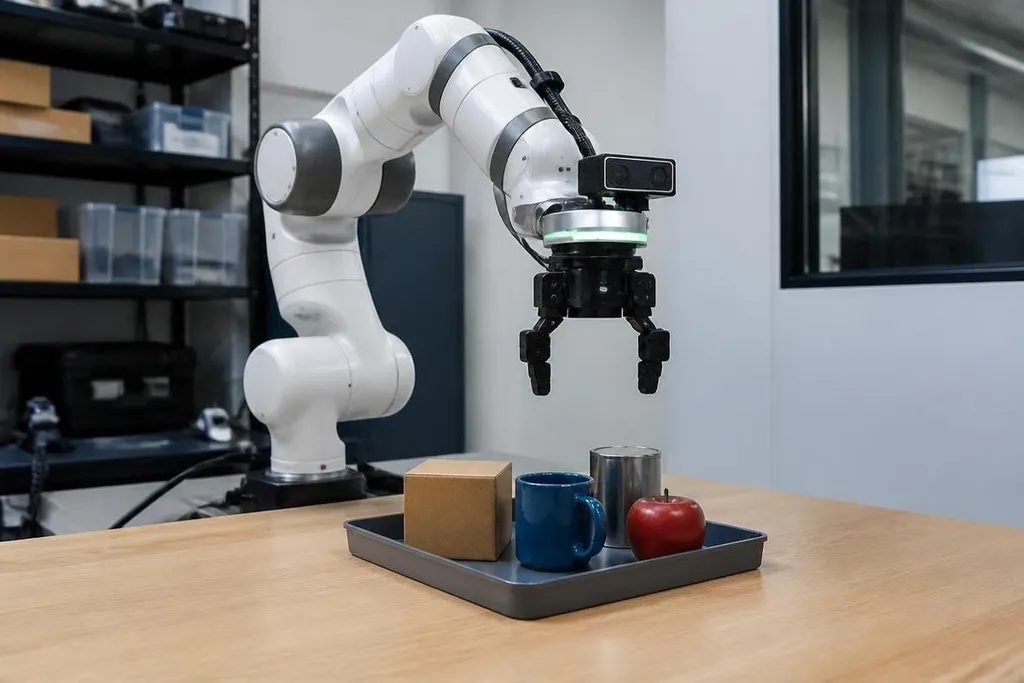
A robot arm can see a cup, but sight alone doesn't tell it where the cup ends or how hard to hold it. Object recognition turns camera and sensor data into a working answer: what is this, where is it, and can I safely move it?
- Images become data: cameras record shape, color, edges, and depth rather than human-style meaning.
- Recognition leads to action: the robot must locate the object, estimate its pose, and choose a grip that fits the task.
From pixels to objects
A camera records a grid of colored values. Software then looks for patterns in those values, such as edges, surfaces, and changes in depth. A 3D camera adds distance for each part of the image, which helps the robot separate a box from the table beneath it.
The robot still doesn't see an object as a person does. It compares the incoming data with patterns learned from training images or with a 3D model stored in its system. The result may be a label such as “bottle,” plus the locations of the pixels that belong to that bottle.
That second part matters. A label without a location can't guide a gripper. The robot needs an outline, often called a mask, that marks the object inside the wider scene.
Finding the object's position
Recognition gives the robot a candidate object. It then estimates the object's position and orientation, known in robotics as its pose. A box lying flat and the same box standing upright may need different arm movements and different contact points.
Depth data helps with this estimate, but it has limits. Shiny metal can confuse some depth cameras. Clear plastic may blend into the background. Thin edges can disappear when the camera sees them from the side. The system may need another view before it acts.
Its camera might sit on the wrist, so every arm movement changes the view. Software converts the camera's measurements into the robot's frame of reference, allowing the arm to reach the position shown in the image.
Recognition is only one part of the job
Correct identification can still lead to a bad pick. The grip depends on weight, material, shape, balance, and the space around the object. A soft package needs a different grip from a rigid tool, even when both fit inside the same image outline.
Force sensors help the robot check contact as the gripper closes. If the fingers meet too soon, the object may be off-center. If the grip force rises too far, a thin item could bend or break. The robot can use that feedback to change its movement instead of relying on the first camera view.
That loop matters when a camera sees an object the robot has not met before. Robot vision reports from Robot24.com give you a reference for comparing what the sensors detect with what the robot can do.
Why unfamiliar objects cause trouble
A system trained on clean images may struggle with clutter, poor lighting, new packaging, or objects partly hidden behind one another. The problem gets harder when several items touch, since the robot must decide where one object stops and another begins.
Training data shapes those limits. If the images show only front views, the system may perform poorly from above. If the data contains few damaged or folded items, those cases can lower the recognition result. A confidence score can tell the robot to pause, request another view, or send the item to a person.
I’d trust a robot more when it can state uncertainty and wait than when it acts on every guess.
A practical check before deployment
Before you judge an object-recognition system, check these points:
- Test the real lighting: include glare, shadows, and low light from the work area.
- Mix the object states: use sealed, open, folded, damaged, and partly hidden items when those cases match the job.
- Measure location error: check how far the predicted object position is from the true position.
- Watch failed picks: record missed edges, wrong labels, slips, and collisions separately.
- Set a safe fallback: give the robot a clear stop, retry, or human-review action when confidence drops.
The useful measure is not how often a robot names an object in a clean image.
It is how often the complete system identifies, reaches, grips, and moves the right item without causing damage. That result still depends on the camera, the training data, the gripper, and the work area, so the next serious test belongs on the real task rather than in a tidy demo.